The IBC and ASCE 7 set the baseline for ground improvement in Texas, yet Plano’s specific geology adds layers of complexity. The local stratigraphy alternates between stiff clays of the Austin Chalk formation and loose, moisture-sensitive alluvial sands, a combination that makes vibrocompaction design both necessary and highly site-specific. Before placing any fill or footing, our laboratory runs ASTM D2487 classification and ASTM D1586 SPT correlations to verify if the in-situ density can be effectively raised through vibratory energy. In practice, we often couple the vibrocompaction layout with a CPT test program to map tip resistance across the entire pad, and when the upper strata show variability, a test pit inspection confirms the presence of organics or debris that would compromise the densification pattern. This integrated approach keeps Plano projects compliant with local amendments to the IBC while avoiding over-treatment.
In Plano’s transitional soils, vibrocompaction is less about depth records and more about hitting a uniform 70 percent relative density across the entire treatment grid.
Our approach and scope
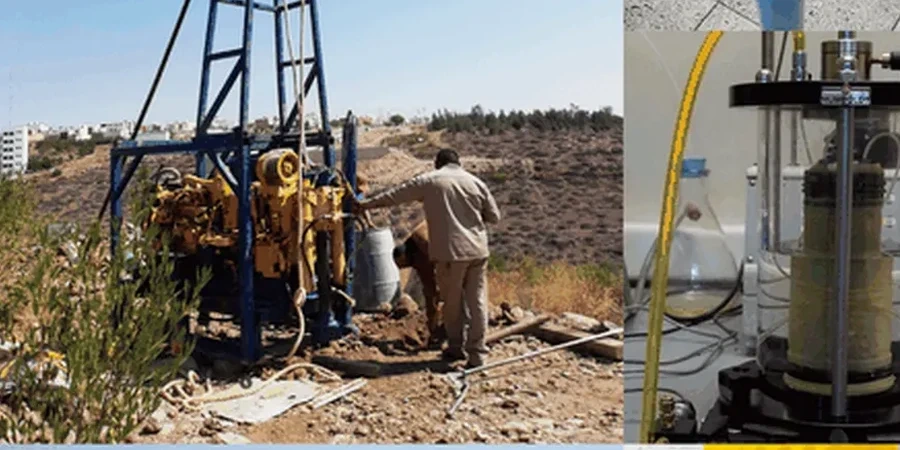
Local considerations
Plano’s rapid expansion eastward from US-75 pushed residential and commercial development onto the Blackland Prairie margins, where native soils often consist of low-plasticity silts and fine sands deposited during the Quaternary. Early subdivisions built on shallow pad footings without deep densification have experienced differential settlement up to two inches within the first five years, a pattern our lab has documented through elevation surveys on multiple distressed slabs. The root cause is usually collapsible soil structure: a metastable fabric that holds under low moisture but collapses abruptly when irrigation or utility leaks introduce water. Vibrocompaction design directly addresses this hazard by collapsing the soil structure under controlled conditions before construction begins, essentially front-loading the settlement. If the treatment depth misses a secondary loose lens at depth, the risk migrates downward, which is why we insist on continuous CPT logs rather than discrete SPT intervals.
Relevant standards
IBC 2021 – Section 1804 Allowable Bearing and Ground Improvement, ASCE 7-22 – Chapter 20 Site Classification and Geotechnical Investigation, ASTM D1586 – Standard Penetration Test (SPT) and Split-Barrel Sampling, ASTM D2487 – Unified Soil Classification System, ASTM D5778 – Electronic Friction Cone and Piezocone Penetration Testing (CPTu)
Related services
Soil Characterization and Treatability Study
We perform grain-size analysis, Atterberg limits, and moisture-density relationships to determine whether the on-site material is suitable for vibratory densification or requires blending.
Full-Scale Field Trial and Parameter Selection
A test section is executed with variable probe spacing and cycle times, monitored through real-time CPT to lock in the optimal work sequence before production starts.
QA/QC Density Verification and Sign-Off Report
Post-treatment CPT soundings at grid centroids, plus sand cone tests on the upper foot, compiled into a sealed report for the Plano building department.
Typical parameters
Common questions
At what soil condition does vibrocompaction stop being effective in Plano?
Once the fines content passing the No. 200 sieve exceeds 15 to 20 percent, vibratory energy cannot efficiently drain pore pressure or rearrange grains. In those cases we transition to stone columns or rigid inclusions. Our lab determines the cutoff early through washed gradation tests.
How deep can a vibrocompaction rig treat on a typical Plano site?
Standard crane-suspended vibrators reach 10 to 12 meters (33 to 40 feet), which covers most loose alluvial deposits in the area. Deeper lenses require bottom-feed stone columns or extended mast rigs, but those are uncommon within Plano city limits.
What is the typical cost range for vibrocompaction design and field control in Plano?
For a design package that includes lab classification, field trial supervision, and QA/QC verification, the professional fee typically runs between US$1,260 and US$5,190 depending on pad size, number of test sections, and the density of CPT soundings required.
Does the Plano building department require post-treatment verification before footing placement?
Yes. The city reviews a sealed geotechnical report with pre- and post-treatment density data as part of the foundation permit package. We provide CPT logs and sand cone results that demonstrate the design relative density has been achieved across the entire treatment area.