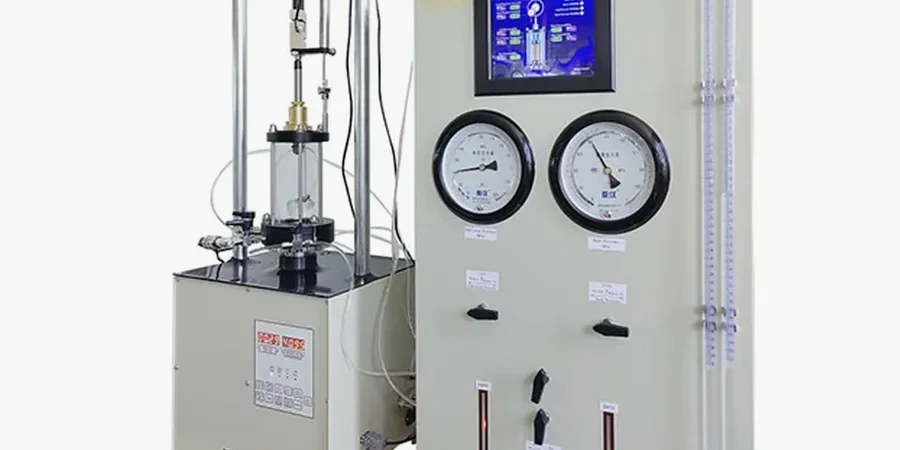
Plano sits on the Austin Chalk formation but most construction deals with the overlying Taylor Marl and expansive alluvial clays—soils that can lose significant strength when saturated. At 675 feet elevation in the Blackland Prairie, the clay here holds water and swells. When you're putting in a foundation on a commercial lot off Preston Road or near Legacy, the triaxial test becomes the only lab method that realistically replicates the in-situ stress path. We see projects where standard penetration data isn't enough because the developer needs the true phi angle and cohesion to model a slope or size a retaining wall. That's what the triaxial cell delivers: controlled confinement, measured pore pressure, and a failure envelope you can take straight to the geotechnical engineer.
We run these tests on Shelby tube samples extracted from 15 to 30 feet depth—where most Plano footings bear—and report the effective stress parameters per ASTM D4767.
A 3% error in the friction angle from a poorly run triaxial test can undersize a foundation by 15% or more in expansive clay.
Our approach and scope
For projects near the Trinity River floodplain, where silty lenses complicate the profile, we often pair the triaxial with a grain size analysis to confirm fines content and with Atterberg limits to bracket the plasticity range. The combined dataset tells you whether the material will behave as a drained or undrained soil under construction loading.
Local considerations
Here's something we see repeatedly in Plano: a contractor takes a bulk sample, molds it at 'optimum' moisture, runs an unconfined compression, and calls it a day. That works for a driveway maybe, but it's a risk for a two-story medical building on stiff clay. The UC test gives zero confinement—zero. A triaxial test with 15 psi cell pressure can show a 40% drop in shear strength compared to the UC value, simply because the pore pressure response during shear reduces effective stress. If your structural engineer designed the footing width using an inflated UC strength, you're building on a margin that doesn't exist. The Plano building permit review increasingly asks for effective stress parameters on projects requiring a geotechnical report, and that means consolidated-undrained or consolidated-drained triaxial data.
Relevant standards
ASTM D4767-11: Standard Test Method for Consolidated Undrained Triaxial Compression Test for Cohesive Soils, ASTM D2850-15: Standard Test Method for Unconsolidated-Undrained Triaxial Compression Test on Cohesive Soils, ASTM D7181-20: Standard Test Method for Consolidated Drained Triaxial Compression Test for Soils, ASTM D4220/D4220M-14: Standard Practices for Preserving and Transporting Soil Samples
Related services
Consolidated-Undrained (CU) with Pore Pressure Measurement
The most common request for Plano foundation design. We consolidate the specimen to the estimated in-situ stress, then shear undrained while recording excess pore pressure. You get both total and effective stress envelopes—critical for short-term stability analysis on saturated clay.
Consolidated-Drained (CD) Triaxial
Used when long-term drained conditions govern, such as permanent retaining walls or slopes. The slow shear rate allows full pore pressure dissipation. We determine the drained friction angle φ' and effective cohesion c' for limit equilibrium modeling.
Unconsolidated-Undrained (UU) Triaxial
A quick-look test for end-of-construction conditions on low-permeability soils. We apply cell pressure and shear immediately without consolidation. The undrained shear strength Su is used for bearing capacity calculations under short-term loading.
Typical parameters
Common questions
How much does a triaxial test cost in Plano?
A single triaxial test with pore pressure measurement typically ranges from US$1,770 to US$2,460, depending on whether it's a UU, CU, or CD test. A CU test with back pressure saturation is at the upper end because of the longer consolidation phase and the extra instrumentation. Most Plano projects need a set of three specimens at different confining pressures to define the Mohr-Coulomb envelope, so we quote per set.
How long does it take to get triaxial test results?
A consolidated-undrained test with pore pressure measurement usually takes 7 to 10 working days from sample receipt. The consolidation phase alone can run 24 to 48 hours on stiff Plano clay. Drained tests are slower—plan on two full weeks because the shear rate must be matched to the soil's permeability. We expedite reporting for time-sensitive foundation redesigns when the client requests it.
What sample quality do you need for a reliable triaxial test?
Undisturbed Shelby tube samples are the standard. The tube must be sealed with wax immediately after extrusion in the field and protected from freezing or drying. We reject samples with visible fissures, gravel inclusions, or signs of disturbance from hammer-driven samplers. For Plano's stiff clay, thin-walled tubes pushed with a hydraulic rig yield the best recovery and the least sample disturbance.
Which triaxial type do I need for a retaining wall design?
That depends on the drainage condition your engineer is modeling. For short-term construction conditions where the wall is backfilled with clay, a CU test with pore pressure measurement gives the undrained strength for bearing and the effective stress parameters for long-term analysis. If the wall is free-draining and you're analyzing permanent conditions, a CD test is more appropriate. We can advise once we see the design scenario and the soil profile.