A three-story medical office building off Preston Road started showing slab distress within eighteen months of completion — not because of structural failure, but because the initial site investigation missed a lens of high-plasticity Eagle Ford Shale at variable depth. We were called in to run a comprehensive soil mechanics study, including undisturbed sampling and triaxial testing, and the forensic analysis revealed differential heave exceeding two inches across the slab footprint. In Plano, where the surface geology looks deceptively uniform but the transition between the Austin Chalk and Taylor Marl formations creates abrupt stiffness contrasts, skipping a rigorous soil mechanics study is a gamble that even experienced developers lose. Our team combines decades of North Texas geotechnical practice with laboratory protocols calibrated to the expansive soil behavior that dominates Collin County.
Plano's expansive clay can develop swell pressures exceeding 10,000 psf — enough to lift a lightly loaded slab several inches if the foundation design ignores seasonal moisture cycles.
Our approach and scope
Local considerations
IBC Section 1803 requires a complete geotechnical investigation for any structure classified under Risk Category II or higher, and the City of Plano engineering division enforces this through the permit review process with particular attention to expansive soil mitigation. What catches many out-of-town developers off guard is the seasonal moisture fluctuation depth: in Plano's climate, with annual rainfall around 39 inches concentrated in spring and a long dry summer, the active zone extends to roughly 12 to 15 feet below natural grade. A soil mechanics study that stops at 10 feet misses the full envelope of moisture-driven volume change. We have seen projects where the original investigation recommended a post-tensioned slab based on shallow data, only for edge lift to appear after two drought cycles. The cost of a proper study — covering deep borings, swell-consolidation testing, and sulfate analysis — is negligible compared to the structural remediation that follows a missed expansive clay diagnosis.
Relevant standards
IBC 2021 Chapter 18 (Soils and Foundations), ASCE 7-22 Section 12.6 (Site classification for seismic design), ASTM D1586 (Standard Penetration Test), ASTM D2487 (Unified Soil Classification System), ASTM D4546 (One-dimensional swell/collapse)
Related services
Deep Soil Boring and Laboratory Testing Program
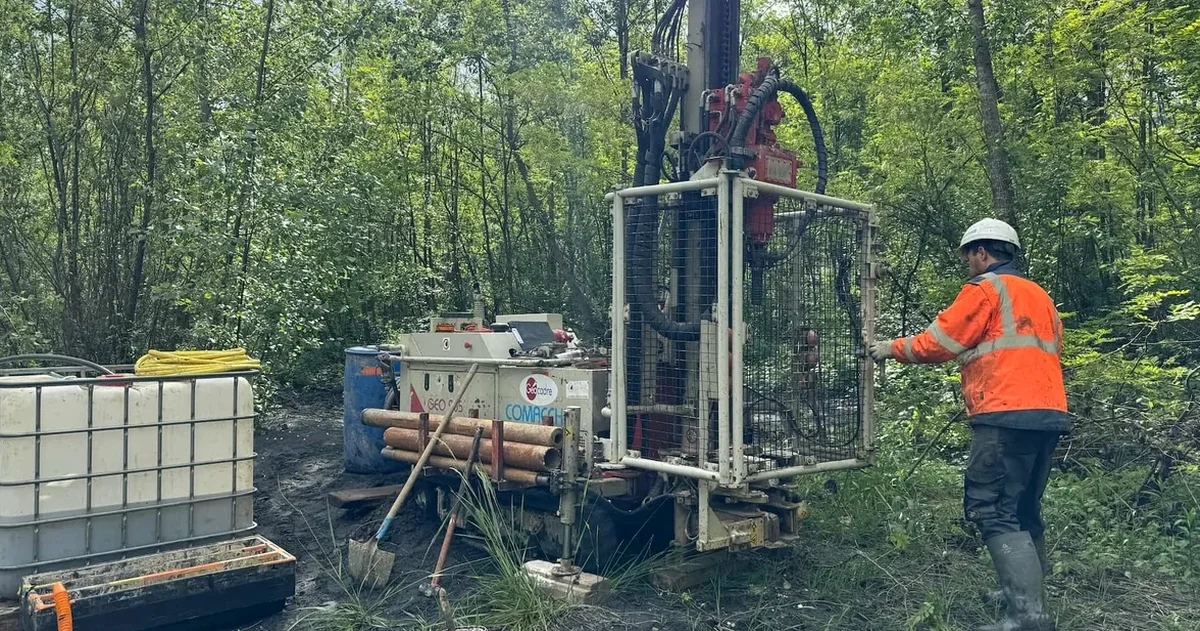
Hollow-stem auger borings to 30 feet or limestone refusal, with Shelby tube recovery, Atterberg limits, sieve analysis, CU triaxial testing, and swell-consolidation per ASTM D4546. We provide bearing capacity recommendations using both Terzaghi and Meyerhof methods, with reduction factors calibrated to local practice in Collin County.
Forensic Soil Mechanics for Distressed Structures
When a slab or foundation shows cracking, heave, or settlement, we run a targeted investigation comparing as-built conditions to original design assumptions. This typically involves hand-auger borings adjacent to the foundation, moisture content profiling through the active zone, and laboratory swell testing on undisturbed samples to quantify the gap between predicted and actual soil behavior.
Typical parameters
Common questions
How deep should a soil mechanics study go for a commercial building in Plano?
The IBC requires borings to extend through all unsuitable strata and at least 30 feet below grade unless bedrock is encountered sooner. In Plano, where the active zone for expansive clay extends 12 to 15 feet deep, we typically recommend reaching at least 30 feet or auger refusal on limestone — whichever comes first — to capture the full moisture-sensitive profile and provide reliable bearing capacity values.
What laboratory tests are most critical for Plano's expansive soils?
Atterberg limits and particle size distribution establish the classification, but the real decision-driving data comes from one-dimensional swell-consolidation testing per ASTM D4546 and consolidated-undrained triaxial shear with pore pressure measurement. Sulfate content testing per ASTM C1580 is also essential here, as several Plano subdivisions sit on pyritic shale that can attack concrete over time.
How much does a soil mechanics study cost for a typical Plano project?
For a standard commercial or multi-family project in Plano, a complete soil mechanics study — including three to five borings, Shelby tube sampling, Atterberg limits, sieve analysis, swell testing, triaxial shear, and a signed geotechnical report with foundation recommendations — typically ranges from US$2,760 to US$5,520 depending on depth, number of borings, and laboratory scope.
Can I use a prior soil report from an adjacent lot?
The City of Plano generally does not accept geotechnical reports from adjacent parcels unless the new report explicitly references and validates the old data with at least one new boring on the subject lot. Soil conditions here can change dramatically within a few hundred feet — especially near the geologic contact between the Austin Chalk and Taylor Marl — so relying on a neighbor's report introduces significant liability.