The most expensive mistake we see in Plano commercial construction is treating rigid pavement design as a purely structural exercise. A contractor pours a 6-inch reinforced slab over what looks like firm clay, and by the second summer, joints are faulting and panels are curling at the edges. The problem isn't the concrete mix. It's the subgrade. Plano sits on the Taylor Marl and Eagle Ford formations, both notorious for volumetric swings with seasonal moisture. A pavement section that works in Dallas often fails here because the plasticity index and sulfate levels are higher than assumed. We run the material characterization that the sand cone density test alone cannot provide, combining stiffness modulus with chemical analysis to prevent mid-panel cracking and premature joint deterioration before the warranty expires.
In Plano's fat clay, the difference between a 20-year and a 40-year concrete pavement is 18 inches of properly compacted select fill and a verified k-value.
Our approach and scope
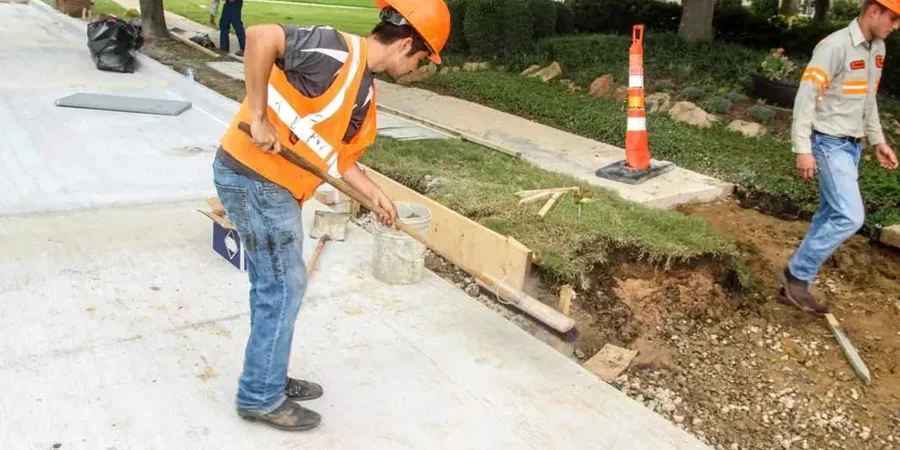
Local considerations
Drive from the older Legacy business park area to the newer developments east of US-75, and you'll notice the pavement condition changes noticeably within a mile. The western zones sit on thinner clay veneers over limestone, offering better drainage and less vertical movement. East of the highway, the soil profile deepens to 15 feet or more of high-plasticity clay that can lift a slab 3 inches between August and February. Ignoring this transition when designing a rigid pavement leads to differential heave at the property line. The worst case we reviewed involved a tilt-up distribution center where the truck court heaved enough to misalign the dock levelers, costing the owner $180,000 in retrofit doweling and slab replacement. A $4,000 geotechnical investigation and a site-specific rigid pavement design would have prevented every dollar of that loss.
Video resource
Relevant standards
ACI 318-19: Building Code Requirements for Structural Concrete, ASTM D1586: Standard Test Method for Standard Penetration Test (SPT) and Split-Barrel Sampling of Soils, ASTM D2487: Standard Practice for Classification of Soils for Engineering Purposes (Unified Soil Classification System), ASCE 7-22: Minimum Design Loads and Associated Criteria for Buildings and Other Structures, IBC 2021: International Building Code, Chapter 18 Soils and Foundations, AASHTO 1993 Guide for Design of Pavement Structures
Related services
Subgrade Resilient Modulus Testing
Repeated load triaxial per AASHTO T307 to obtain Mr values at multiple moisture conditions, simulating the seasonal variation Plano subgrades experience.
Sulfate Attack Mitigation Design
Ion chromatography to quantify water-soluble sulfate in the subgrade, with specific cement type and water-cement ratio recommendations per ACI 318 exposure classes.
Plate Load Testing for k-Value
Field modulus of subgrade reaction using a 30-inch diameter plate, cycled to replicate service loads and provide the k-value for Westergaard edge stress calculations.
Joint and Reinforcement Layout
Design of contraction joint spacing, dowel diameter and spacing, and distributed steel percentage based on the PCA method and local temperature data for Collin County.
Typical parameters
Common questions
What is the typical cost range for a rigid pavement design on a Plano commercial lot?
For a Plano commercial lot under 5 acres, the rigid pavement design package including site investigation, laboratory testing, and the sealed report generally ranges from US$1,860 to US$5,750. The final cost depends on the number of borings, the depth of the exploration, and the extent of chemical testing required for sulfate exposure classification.
How does the expansive clay in Plano affect concrete pavement performance?
Plano's fat clay can change volume by 10% or more between dry summer and wet winter conditions. This seasonal movement creates uneven support under the slab, leading to corner breaks, transverse cracking, and faulting at the joints. A rigid pavement design compensates by specifying a thicker, moisture-conditioned base course and, in severe cases, a lime-stabilized subgrade to reduce the plasticity index before paving.
Do you base the design on the PCA method or the AASHTO 1993 guide?
We use both, applying the PCA method for the fatigue analysis of the slab and the AASHTO 1993 guide for the overall structural number and reliability factors. The final recommendation is always calibrated to the specific k-value and flexural strength measured for your Plano project, not to default regional tables.
What certifications does your laboratory hold for the concrete and soil testing?
Our laboratory operates under a quality management system aligned with ISO 17025 for the relevant ASTM test methods, including compressive strength, flexural strength, sulfate content, and soil classification. All field technicians hold ACI Concrete Field Testing Technician Grade I certification, and the engineering reports are sealed by a Professional Engineer licensed in Texas.