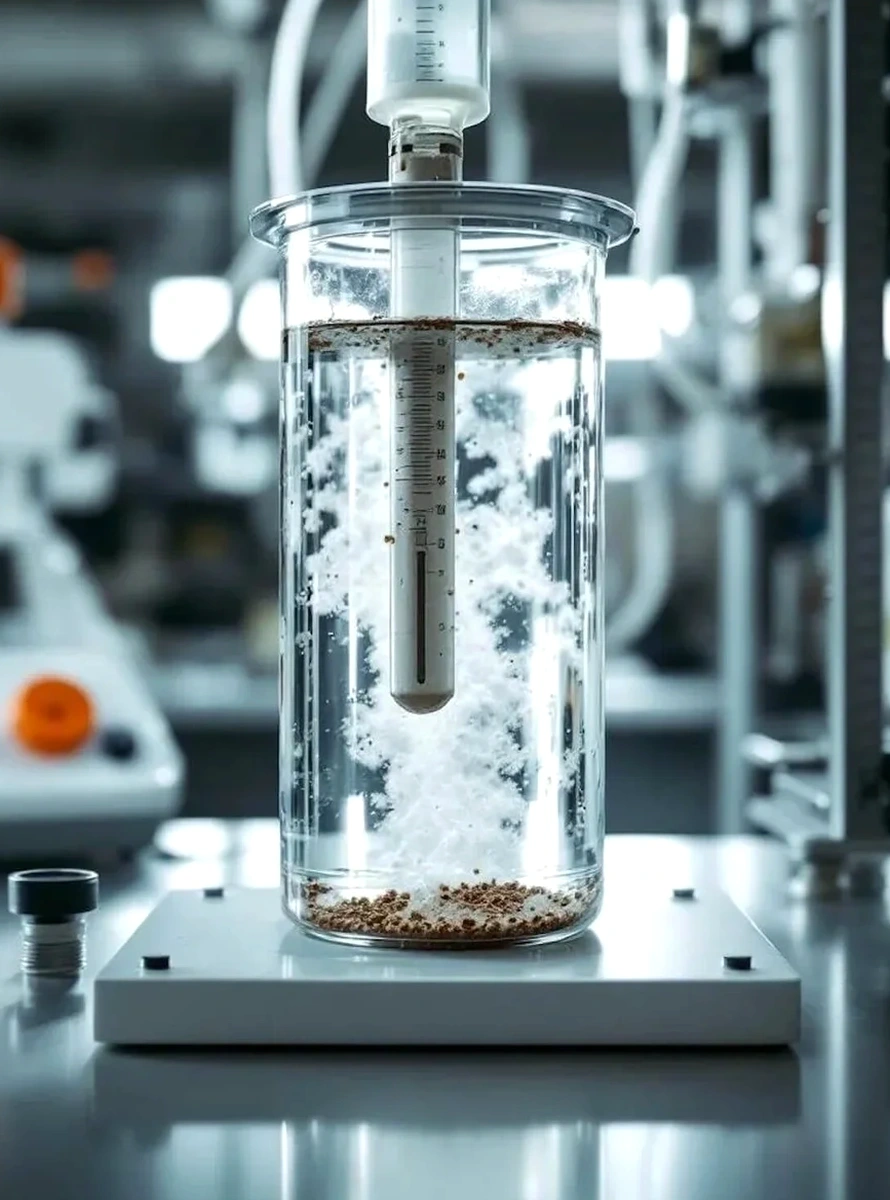
The difference in soil between a site near Legacy West and one out by Oak Point Park can be night and day. One might hit fat clay within two feet, the other a silty sand that drains beautifully. When you're dealing with Plano's notorious Blackland Prairie soils, a basic visual classification just won't cut it. You need a full grain size analysis to nail down the USCS group symbol and predict how the material will behave under load. Our lab runs the complete ASTM D6913 sieve stack plus D7928 hydrometer sedimentation to cover everything from gravel down to colloidal clay. This isn't just about compliance; it's about avoiding a foundation design that fights the soil instead of working with it.
You can't out-engineer a bad soil classification. The hydrometer tells the real story that a sieve stack misses.
Our approach and scope
- Complete particle size distribution curve from 75 mm to 0.001 mm.
- Coefficient of uniformity (Cu) and curvature (Cc) calculated for every report.
- Sample prep follows ASTM D421 including oven-drying and mechanical splitting for representative fractions.
Local considerations
The most common mistake we see in Plano is builders running only a wash #200 on a fill material and skipping the full hydrometer. They get a bulk fines percentage and assume the material is non-plastic silty sand. Then a few wet-dry cycles hit, the clay fraction hydrates, and you've got volume change cracking the slab. That's a callback nobody wants. Without the full grain size curve and an Atterberg limits cross-check, you're guessing on the soil's activity and its potential to shrink or swell. In a region where the Plasticity Index can swing from 15 to 40 in a single block, skipping the sedimentation analysis is a gamble on your foundation's long-term performance. The combined sieve and hydrometer report is your first line of defense against misclassifying a reactive clay as an inert silt.
Video resource
Relevant standards
ASTM D6913 - Standard Test Methods for Particle-Size Distribution (Gradation) of Soils Using Sieve Analysis, ASTM D7928 - Standard Test Method for Particle-Size Distribution (Gradation) of Fine-Grained Soils Using the Sedimentation (Hydrometer) Analysis, ASTM D2487 - Standard Practice for Classification of Soils for Engineering Purposes (Unified Soil Classification System), ASTM D421 - Standard Practice for Dry Preparation of Soil Samples for Particle-Size Analysis and Determination of Soil Constants, IBC 2021 - Section 1803 Geotechnical Investigations
Related services
Full Curve Sieve + Hydrometer Package
Mechanical sieve analysis from 3 inches down to #200 combined with hydrometer sedimentation to 0.001 mm. Includes log-scale gradation plot, Cu/Cc coefficients, and USCS classification per ASTM D2487. Typical turnaround 48 hours.
Fill Material Verification Suite
Targeted testing for select fill and subgrade confirmation. We run the full hydrometer on every imported fill source to verify the fines content and plasticity match the project specs before compaction placement begins.
Typical parameters
Common questions
Why do I need a hydrometer test if the sieve already tells me the sand and gravel percentages?
The sieve stops at the #200 mesh, which is 75 microns. Everything finer than that — silt and clay — passes through and gets lumped together as 'fines.' The hydrometer separates them by measuring how fast particles settle in a fluid column, giving you the true clay fraction. In Plano's Blackland Prairie, that clay fraction controls the soil's swell potential, so skipping it means you're designing without understanding the most reactive component of the soil.
What's the typical cost for a combined sieve and hydrometer analysis in Plano?
A full grain size analysis package with sieve and hydrometer runs between US$110 and US$160 per sample, depending on whether we're doing a full stack or a reduced set. If you need the Atterberg limits run on the same sample to complete the USCS classification, that's quoted separately but we can bundle it for efficiency.
How much sample material do you need from the field?
For a combined sieve and hydrometer, we need about 500 grams of material passing the #4 sieve for the fine portion, plus enough bulk material to run the full coarse sieve stack. A gallon-sized bag of representative material from your test pit or SPT split spoon is usually sufficient. If the soil has significant gravel, we'll need more bulk to meet the minimum mass requirements in ASTM D6913.
Can you run this on samples from outside Plano, like McKinney or Frisco?
Absolutely. We regularly receive samples from across Collin County and the broader DFW metroplex. The soils in Frisco and McKinney share the same expansive clay challenges as Plano, so the ASTM D7928 hydrometer method is equally critical there. We can arrange sample pickup or you can drop them at our receiving window during business hours.