Plano sits on the Blackland Prairie, a band of highly plastic, expansive clay that runs right through Collin County. When that clay gets wet, it swells; when it dries, it cracks foundations. Traditional shallow footings on this formation demand deep over-excavation and select fill, which costs time and money. Stone column design changes the equation. Instead of hauling off hundreds of yards of fat clay, we install compacted aggregate columns that densify the surrounding soil and create a composite mass with predictable bearing capacity. For the retail pads along Preston Road or the warehouse expansions near Legacy business park, this approach often cuts earthwork by half while delivering a settlement-tested subgrade. We cross-reference site-specific data from the CPT test to refine column spacing and length before any rig mobilizes, because Plano’s clay lenses vary block by block.
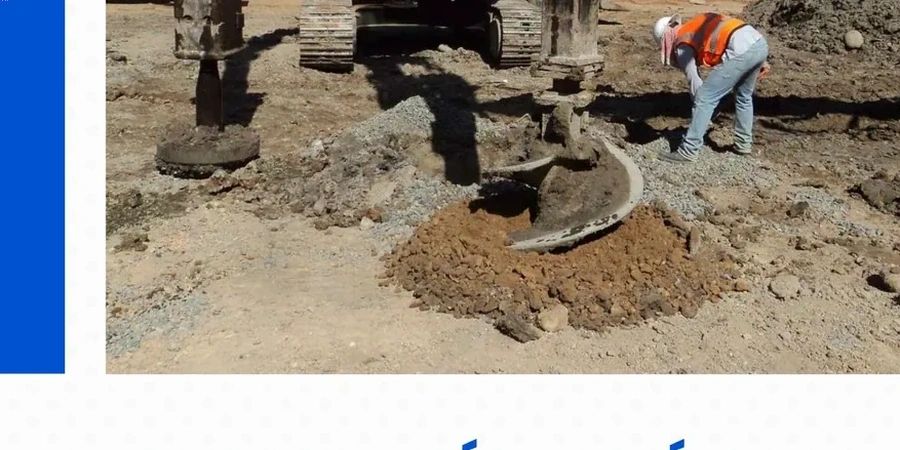
A well-designed stone column grid turns Collin County fat clay into a predictable, drain-capable foundation medium without over-excavation.
Our approach and scope
Local considerations
The most common mistake we see on Plano job sites is specifying stone columns based on a desk study without confirming the actual clay plasticity. A general report might call out ‘stiff clay,’ but if the PI is above 35 and the natural moisture content is near the plastic limit, untreated columns will remold the sidewalls and lose confinement during installation. We’ve walked onto sites where a previous contractor punched columns into saturated gray clay and ended up with bulging failures at 15 feet because the lateral pressure simply wasn’t there. The fix always starts with a current geotechnical investigation—grain size analysis plus Atterberg limits on split-spoon samples—to nail down the fines content and plasticity index before design. Skipping that step can turn a ground improvement solution into a schedule delay that costs more than the earthwork it was meant to replace.
Relevant standards
IBC 2024 Chapter 18 (Soils and Foundations), ASCE 7-22 Section 12.13 (Foundation Design Requirements), ASTM D1586 (Standard Penetration Test), ASTM D2487 (Unified Soil Classification System), FHWA NHI-16-072 (Ground Improvement Methods)
Related services
Stone Column Design Package
Full design submittal including bearing capacity analysis, settlement calculations, column layout drawings, aggregate spec, and installation sequence. Stamped by a Texas-licensed engineer for Plano permit review.
Post-Installation Verification Testing
Modulus load tests on completed columns plus zone CPT soundings between columns to confirm densification. We deliver a compliance report tied to the IBC acceptance criteria before the slab is placed.
Typical parameters
Common questions
How much does stone column design and testing cost for a typical Plano commercial lot?
For a standard commercial pad up to two acres, the design package and post-installation modulus testing generally falls between US$1,640 and US$5,380, depending on the number of verification points required and the complexity of the soil profile. Sites with highly variable clay strata or deeper columns beyond 20 feet tend toward the upper end of that range because they demand additional CPT soundings to confirm densification between columns.
At what depth do Plano’s expansive clays become manageable for stone columns?
The active zone of moisture fluctuation typically extends to about 12 feet in Collin County. Below that, natural moisture content stabilizes and the clay becomes stiffer. We usually design columns to penetrate at least 3 to 5 feet into that stable zone, so total column depths of 15 to 20 feet are common across Plano. Shallower columns rarely provide the confinement needed for long-term settlement control.
Does the city of Plano require special inspections for stone column installation?
Plano follows IBC Chapter 17 requirements for special inspections on ground improvement. The building department will expect a statement of special inspections prepared by the design engineer, plus continuous observation during column installation and documented verification testing afterward. We handle that documentation as part of the design package so the contractor isn’t chasing paperwork mid-installation.
Can stone columns replace deep foundations for a two-story structure on Plano clay?
In many cases, yes. If the design bearing pressure stays within the 3,500 to 5,000 psf range that treated ground can reliably deliver, stone columns often eliminate the need for drilled piers or piles under lightly loaded two-story buildings. The key is confirming that total and differential settlement calculations come in under the IBC’s ¾-inch limit for slab-on-grade with masonry veneer. For heavier steel-frame structures, a hybrid approach with isolated footings on columns may still be needed.