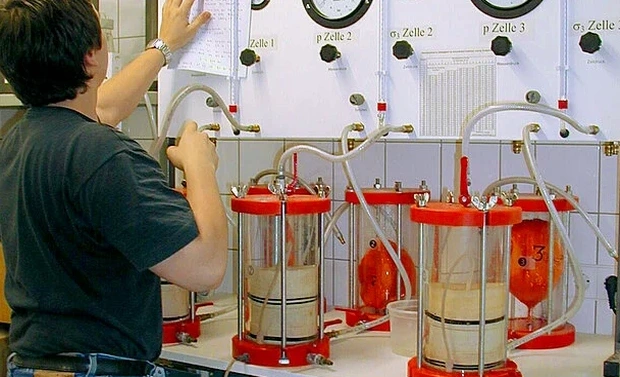
Plano sits squarely on the Blackland Prairie, where fat clays can swell 2 inches in a wet spring and shrink to a network of cracks by August. That movement puts relentless stress on pavements and foundations. The laboratory CBR test takes a compacted sample of that same subgrade and measures its resistance to a standard penetration piston, giving the design team a soaked strength value that reflects worst-case moisture conditions. Without that number, a pavement section is just guesswork: too thin, and the asphalt alligators in three summers; too thick, and the budget bleeds. We run ASTM D1883 in a controlled environment, so the result isn't clouded by weather or field variability. For projects near the 121 corridor or new subdivisions west of Preston, the soaked CBR often lands between 3 and 6 — values that demand either a substantial granular base or lime stabilization before any flexible pavement course goes down.
A soaked CBR of 4 in Plano clay means the subgrade supports one-quarter the load of crushed stone — that single digit dictates the entire pavement section.
Our approach and scope
Local considerations
Plano's population has crossed 285,000, and the city keeps adding lane-miles to keep pace. The 2023 bond program allocated over $200 million to street reconstruction and drainage improvements — work that runs straight through Blackland Prairie subgrades. Skipping a laboratory CBR test on any project that touches a public right-of-way means the design doesn't meet the geotechnical reporting standards the City of Plano Engineering Department expects during plan review. The soaked CBR value directly feeds the AASHTO 1993 pavement design equation, and if it's off by 2 or 3 points, the structural number and layer thicknesses are off by 30% or more. On a half-mile collector street, that error might cost $90,000 in over-excavation or premature overlay. On commercial developments with fire-lane access and dumpster pads, a miscalculated subgrade modulus leads to edge cracking within 18 months. The test also provides the data needed for rigid pavement thickness validation when the project calls for concrete streets, which Plano favors for its longevity in reactive clay environments.
Relevant standards
ASTM D1883: Standard Test Method for California Bearing Ratio (CBR) of Laboratory-Compacted Soils, ASTM D1557: Standard Test Methods for Laboratory Compaction Characteristics of Soil Using Modified Effort, ASTM D698: Standard Test Methods for Laboratory Compaction Characteristics of Soil Using Standard Effort, AASHTO T 193: The California Bearing Ratio, TxDOT Tex-117-E: Triaxial Compression for Disturbed Soils (referenced for companion testing)
Related services
Standard & Modified Proctor
Determines the maximum dry density and optimum moisture content of the site soil so the CBR specimen is compacted to field-equivalent conditions.
Atterberg Limits
Measures liquid limit, plastic limit, and plasticity index of Plano's high-PI clays to predict swell potential and classify the soil under the Unified Soil Classification System.
Swell Testing
Quantifies the volume change of a compacted specimen during the 96-hour CBR soak, providing the expansion percentage that governs edge restraint and joint design.
Typical parameters
Common questions
How much does a laboratory CBR test cost in Plano?
A single-point laboratory CBR test with modified Proctor compaction and 4-day soak typically runs between US$140 and US$210 per specimen, depending on whether it's part of a larger testing package. Most Plano paving projects need 2–3 points to bracket the moisture range, and we can quote a package rate once we see the geotechnical report scope.
How long does the lab CBR test take from sample to report?
The soaking period alone is 96 hours per ASTM D1883. With specimen preparation, compaction, and post-soak penetration testing, you're looking at 5–6 business days for a single point. Expedited processing is available when the grading contractor is waiting on a subgrade acceptance number.
Do Plano residential projects require a laboratory CBR?
For single-family slabs, the geotechnical report typically focuses more on Atterberg limits and swell potential. But for subdivision streets, alleys, and private access drives that will be dedicated to the city, the City of Plano Engineering Department often requires a design CBR value in the pavement report, especially when the street section will be accepted into the public maintenance system.
What CBR value do you typically see in Plano clay?
Unmodified, soaked Blackland Prairie clay in Plano usually falls between CBR 2 and 6. With 5–6% lime stabilization and proper mellowing, that same soil can reach CBR 15–25, which changes the required base thickness significantly. We can run parallel specimens — one raw, one stabilized — to quantify the improvement and optimize the pavement design.