The geology under Plano sits squarely on the Eagle Ford Shale, a formation that keeps local engineers on their toes. You've got highly plastic clay at the surface that swells when it rains and shrinks during our 100-degree summer streaks, then transitions into weathered shale that can be surprisingly competent or completely fractured depending on the depth. What we run into time and again across Plano is that standard retaining wall designs fail because they underestimate the lateral pressure these expansive soils generate when they get wet. For commercial developments along the Dallas North Tollway corridor or residential retaining walls in neighborhoods like Willow Bend, anchor design has to account for moisture fluctuation zones that extend deeper than most textbook assumptions. Our team combines test pit observations with laboratory index testing to verify the actual plasticity of the clay before selecting anchor type and bond length.
An anchor is only as reliable as the bond zone—and in Plano's Eagle Ford Shale, that bond zone starts below where the weather stops.
Our approach and scope
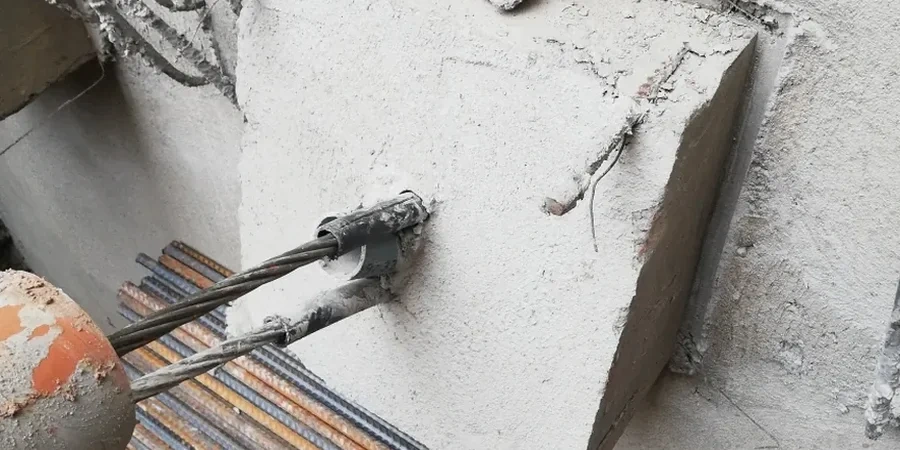
Local considerations
IBC Chapter 18 and the City of Plano's adopted building code amendments require that earth retention systems account for expansive soil pressures—and that's not a checkbox exercise here. What we've observed on multiple Plano sites is that active anchors can lose prestress load over the first wet season if the clay behind the wall hasn't been properly drained. Passive anchors have a different failure mode: they rely on soil deformation to engage, and if the deformation needed exceeds what the retained structure can tolerate, you'll see cracking in the wall before the anchor ever reaches its working capacity. The insurance cost of an under-designed anchor system in Collin County isn't just the repair bill—it's the potential for a cascading failure where a retaining wall moves, utility lines shift, and adjacent pavement slabs crack. We always recommend a drainage plan that routes water away from the anchor zone, and for permanent installations, we specify encapsulated tendon systems that isolate the steel from Plano's occasionally sulfate-rich groundwater.
Relevant standards
ASCE 7-22 Minimum Design Loads for Buildings and Other Structures, IBC 2021 Chapter 18 Soils and Foundations, PTI DC-35.1 Recommendations for Prestressed Rock and Soil Anchors, ASTM A722 Standard for Uncoated High-Strength Steel Bars for Prestressing, City of Plano Building Code Amendments
Related services
Active Anchor Design
Prestressed anchors for permanent retaining walls and deep excavation support. We size the bond length based on site-specific soil parameters, not generic tables, and specify the lock-off load to account for long-term relaxation in Plano's clay.
Passive Anchor Systems
Grouted or mechanical anchors that engage through soil deformation. Commonly used for temporary shoring, slope stabilization, and tieback systems where access for stressing jacks is limited.
Anchor Testing and Verification
Performance and proof testing to confirm that installed anchors meet the design capacity. We monitor creep displacement during hold periods and correlate results back to the geotechnical baseline report.
Typical parameters
Common questions
How much does anchor design and testing cost for a Plano project?
For a typical Plano retaining wall or shoring project, anchor design and proof testing usually falls in the US$1,100 to US$3,860 range depending on the number of anchors, whether they're active or passive, and the depth of the bond zone. A small residential wall with two or three anchors sits at the lower end, while a commercial excavation with multiple tieback rows and full performance testing runs higher. We provide a fixed-fee proposal once we've reviewed the site plan and soil report.
What's the difference between active and passive anchors?
Active anchors are tensioned after installation—we apply a specified prestress force against the wall or structure, which immediately restricts movement. Passive anchors aren't prestressed; they develop resistance as the soil mass moves and loads the anchor. In Plano, active systems are preferred for permanent structures where you can't afford any wall deflection, while passive anchors work well for temporary excavation support where some controlled movement is acceptable.
How deep do anchors need to go in Plano's soil?
The bond zone needs to extend below the active moisture fluctuation layer, which in Plano can reach 12 to 15 feet deep depending on vegetation cover and drainage. We typically design bonded lengths of 15 to 40 feet past that zone, anchoring into the more stable shale or limestone bedrock. The exact depth comes from the geotechnical exploration—we correlate borehole data with anchor capacity requirements to determine the minimum embedment.
Do I need a building permit for anchor installation in Plano?
Yes, retaining walls over four feet in height and any anchored earth retention system require a building permit from the City of Plano. The submittal package needs to include sealed calculations demonstrating compliance with IBC Chapter 18 and the city's geotechnical report requirements. We prepare the design package with all required stamps and can coordinate with your structural engineer for a complete submittal.