Plano’s transformation from a quiet farming settlement into a major corporate hub—home to over 290,000 residents—has placed immense pressure on its underlying geology. The city straddles the boundary between the Taylor Blackland Prairie and the Eastern Cross Timbers, a transition zone where highly plastic clays meet weathered limestone. For any structure requiring a grade change, a solid retaining wall design must account for the significant swell potential of the Eagle Ford Shale and the stiff, jointed nature of the Austin Chalk. Our team approaches each project with a forensic understanding of these formations, integrating test pits data to map the contact between residual soil and bedrock before a single load calculation begins. This level of upfront investigation prevents the long-term distress we frequently observe in older commercial developments along the US-75 corridor.
In Plano’s dry summers, clay desiccation cracks can propagate to depths exceeding 10 feet, fundamentally altering the active zone behind a restrained wall.
Our approach and scope
Local considerations
We conducted a forensic review of a 14-foot cantilever wall on Legacy Drive that exhibited a 2-inch outward tilt within three years of construction. The backfill consisted of on-site clay recompacted at 2% below optimum moisture content. During the subsequent wet season, the clay absorbed water, generated swell pressures exceeding 4,500 psf, and overwhelmed the passive resistance of the compacted toe zone. The remedial design involved installing a row of drilled shafts tied back with post-tensioned anchors, effectively converting the cantilever into an anchored system. This case underscores the primary failure mode in Plano: underestimating the lateral thrust from moisture-cycled expansive soils. A retaining wall design that relies solely on granular drainage blankets without addressing the volume change potential of the native backfill is fundamentally incomplete in this region.
Relevant standards
ASTM D1586 (Standard Penetration Test), ASTM D2487 (Unified Soil Classification System), IBC 2021 Chapter 18 (Soils and Foundations), ASCE 7-22 (Minimum Design Loads for Buildings and Other Structures)
Related services
Cantilever and Counterfort Wall Analysis
We perform limit equilibrium and finite element analyses for reinforced concrete stems, optimizing the heel length to resist sliding in the low-friction clay seams common in the upper bedrock interface.
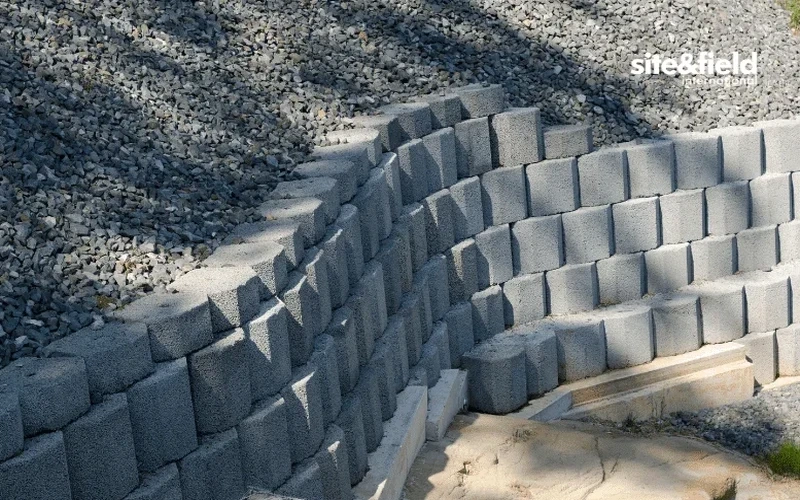
MSE Wall and Modular Block Design
We specify geogrid lengths and vertical spacing based on pullout capacity tests in the compacted select fill, ensuring the reinforced mass remains internally stable against the cyclic wetting and drying of the local soils.
Soldier Pile and Lagging Systems
For deep excavations in the urbanized sections of Plano, we design drilled soldier beams socketed into the Austin Chalk, with wood or shotcrete lagging designed to span the temporary earth pressures between flanges.
Typical parameters
Common questions
Why can’t I just use a standard retaining wall design detail from a pre-engineered manual for my Plano property?
Pre-engineered manuals typically assume a granular, non-expansive backfill with a friction angle of 30 degrees or more and no volume change. The Eagle Ford Shale and Blackland Prairie clays in Plano can develop swell pressures over 5,000 psf when wetted. A standard detail will not account for the low residual friction angles (often below 10 degrees on slickensided surfaces) or the need for an impermeable cap to control moisture infiltration. The IBC requires a site-specific geotechnical investigation for walls over 4 feet, precisely because of these local soil hazards.
What is the estimated cost range for a retaining wall design in Plano?
The design package, covering the geotechnical report, structural calculations, and construction-ready stamped drawings, typically falls between US$1,080 and US$4,150. The variance depends on the wall height, the required depth of the boring program, and whether we need to engage a corrosion specialist for permanent tieback anchors in the chemically active clay environment.
How does the perched groundwater condition affect the long-term stability of my wall?
In Plano, the Austin Chalk acts as a leaky aquitard, causing water to perch seasonally in the overlying weathered clay. We design a composite drainage system—a chimney drain and a blanket drain—to intercept this perched flow. Without it, hydrostatic pressure builds behind the wall, saturating the backfill, reducing the effective stress to zero, and triggering a progressive bearing capacity failure in the foundation soil.