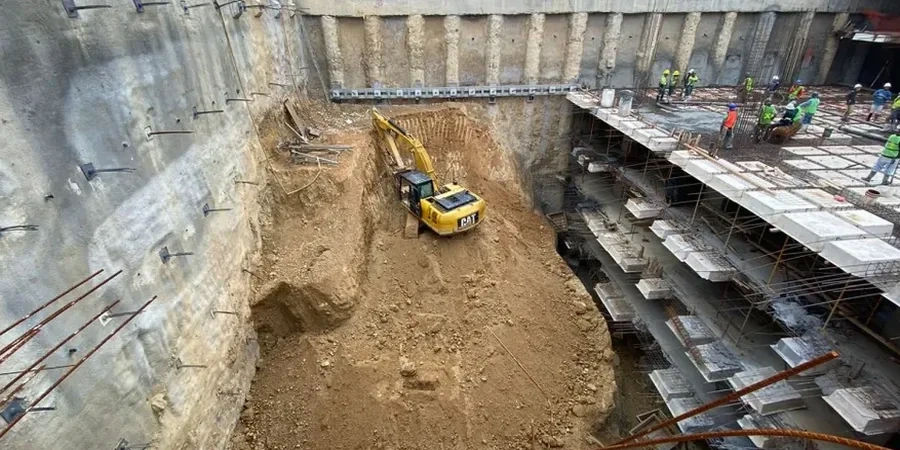
The hydraulic shoring jacks and trench boxes arrive on a flatbed before dawn in Plano. The crew sets up while the air is still cool. Our team designs the support system based on the specific cut depth, soil profile, and nearby surcharge loads. A deep excavation in the DFW metroplex is not a generic exercise. It requires precise calculation of lateral earth pressures, base stability, and groundwater control. The excavation plan specifies strut spacing, waler sizes, and embedment depth for each soldier pile. We rely on data from CPT test to refine the soil strength parameters at the project depth. The goal is a safe, stable cut that allows foundation work to proceed without delays.
A shoring design based on generalized soil parameters fails when it hits a sand lens in the Taylor Marl — we verify every layer.
Our approach and scope
Local considerations
The climate in Plano swings from drought to torrential downpours. A dry cut in August behaves completely differently in May. Uncontrolled water ingress is the number one cause of excavation failure in the Blackland Prairie. We design the dewatering system for the 100-year storm event. The perimeter drains and sump pumps get sized with a factor of safety of two. Another risk is the proximity of existing utilities and adjacent foundations. A deep excavation on Legacy Drive or near the Dallas North Tollway requires vibration monitoring and settlement markers on the adjacent pavement. We specify a pre-construction condition survey. If the monitoring data shows a trend toward movement, the shoring design includes contingency tiebacks that can be tensioned immediately.
Relevant standards
ASTM D1586 (Standard Penetration Test), ASTM D2487 (Soil Classification), IBC Chapter 18 (Soils and Foundations), ASCE 7 (Minimum Design Loads), FHWA shoring design guidelines
Related services
Shoring system design
Complete design of soldier pile, sheet pile, secant pile, and tied-back walls. Includes global stability checks and structural steel calculations.
Dewatering and drainage plans
Design of deep well, wellpoint, and eductor systems to lower the groundwater table below the excavation bottom. Includes discharge permits support.
Typical parameters
Common questions
What is the typical cost range for a deep excavation design in Plano?
For a standard commercial building excavation in Plano, the geotechnical design fee ranges from US$1.890 to US$7.510. The final cost depends on the cut depth, the shoring system type, and the number of review cycles with the city.
How do you handle the expansive clay in Plano during excavation?
The Taylor Marl formation is moisture-sensitive. We specify that the final cut surface must be protected with a membrane or shotcrete within 24 hours. The shoring design assumes a tension crack zone near the surface and reduces the passive resistance accordingly.
What information do you need to start the design?
We need a geotechnical report with boring logs, the architectural basement plan, the site survey with utility locations, and the structural loading at the perimeter columns. This allows us to calculate the surcharge influence on the shoring wall.
Do you provide inspection during excavation?
Yes. We have a field engineer on site during the critical phases: initial soldier pile drilling, tieback proof testing, and the first 10 feet of mass excavation. The engineer verifies that the soil conditions match the design assumptions.
How long does the design and approval process take?
The initial design takes about two weeks after receiving the complete information package. The City of Plano review can add another two to three weeks. We manage the resubmittal process if the reviewer requests clarifications.