In Plano, we often see engineers caught off guard by the combination of highly expansive Houston Black clay and the long-period ground motion potential from faults hundreds of miles away. The soil here swells and shrinks with seasonal moisture swings, but the seismic threat—though moderate—demands a design that decouples the structure from the ground. We approach base isolation not as a standalone product but as a geotechnical-structural interface problem. The isolator’s performance depends entirely on the substrate stiffness we verify through field testing. For a data center off the Dallas North Tollway, we correlated MASW shear wave velocity profiles with CPT tip resistance to define the Vs30 and bearing stratum for the isolation plane. That level of integration is what keeps the period shift predictable.
In Plano’s deep soil sites, a 0.2-second shift in the isolated period can move spectral acceleration from the plateau down to the descending branch, cutting base shear by 40%.
Our approach and scope
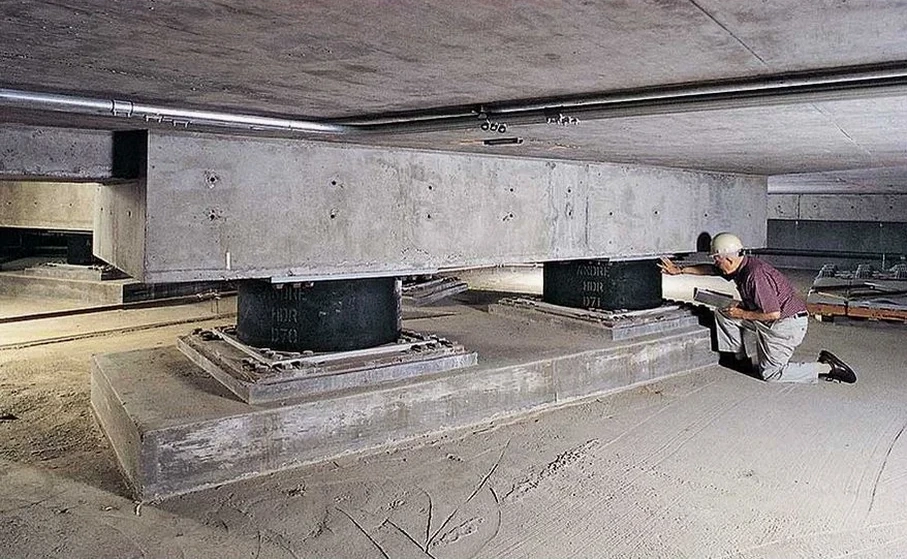
Our team runs a pre-installation survey using a precision digital level and total station to ensure the pedestal top plate is perfectly horizontal. Any deviation introduces eccentricity that shifts the effective stiffness. We also require a friction coefficient test between the isolator’s bottom plate and the grout bed, targeting a minimum coefficient of 0.5. The grout itself is a non-shrink, high-strength mix poured under pressure to fill the annular space completely. We have seen installations in Plano where air pockets in the grout bed led to rocking under service loads—something we catch with thermal imaging during the curing phase.
Local considerations
ASCE 7-22 Section 17 is explicit about the analysis requirements for isolated structures, and in Plano’s Site Class D conditions, the ground motion amplification at mid-periods can be severe. The biggest technical risk we encounter is underestimating the effective period shift due to soil-structure interaction. If the foundation flexibility adds even 0.3 seconds to the fixed-base period, the isolator’s target period may land on a spectral acceleration peak instead of the intended valley. We have seen this in a medical office building near Medical City Plano where initial modeling assumed a rigid base on stiff clay. Our seismic refraction survey revealed a 12-foot layer of desiccated crust over softer material, changing the site period entirely. The fix required adjusting the isolator’s dynamic stiffness and increasing the moat wall clearance by 4 inches.
Another failure mode occurs when the utility connections crossing the isolation plane are not designed with sufficient flexibility. Gas lines, fire sprinkler risers, and electrical conduits must accommodate the full MCE₂ displacement without rupture. We require a looped or bellowed configuration tested to 1.5 times the design displacement.
Relevant standards
ASCE/SEI 7-22 Minimum Design Loads and Associated Criteria for Buildings and Other Structures, IBC 2024 International Building Code Chapter 17, ASTM D4015 Standard Test Methods for Modulus and Damping of Soils, ASTM D7400 Standard Test Methods for Downhole Seismic Testing
Related services
Geophysical Site Characterization for Isolation Design
We run downhole seismic, crosshole, and MASW surveys to build a Vs profile down to 100 feet. This defines the Site Class and provides the shear modulus degradation curves needed for nonlinear time-history analysis.
Bearing Pad Foundation Testing and Inspection
We perform plate load tests on the bearing stratum to confirm the modulus of subgrade reaction used in the isolator pad design. Our field team uses calibrated hydraulic jacks and dial gauges to measure settlement under design pressure.
Isolator Installation Verification and Grout Monitoring
We verify the leveling tolerance, grout compressive strength via cube testing, and friction coefficient at the base plate interface. Post-installation, we conduct a thermal imaging scan to detect voids in the grout bed.
Typical parameters
Common questions
What does a base isolation seismic design project cost in Plano?
For a typical mid-rise essential facility in Collin County, the full package—including geophysical site characterization, geotechnical investigation, isolator testing, and installation inspection—ranges from US$3,610 to US$7,740. The final figure depends on the number of isolators, the complexity of the soil profile, and whether nonlinear time-history analysis is required by the peer review panel.
How does the expansive clay in Plano affect isolator performance?
The Houston Black clay formation dominates Plano’s subsurface. Its swell-shrink potential affects the foundation pad’s long-term levelness. We specify a moisture barrier system around the foundation and often recommend a rigid mat foundation below the isolation plane to bridge over zones of differential heave. The isolator’s vertical stiffness must also be checked against uplift forces from clay swelling pressure, which can exceed 5,000 psf in wet years.
Why is Site Class D the default assumption in Plano and how does that change the isolation design?
Plano’s soil profile typically consists of stiff to very stiff clay in the upper 50 feet, which qualifies as Site Class D with a Vs30 between 600 and 1,200 ft/s. The IBC site coefficients for Class D amplify the short-period and mid-period spectral acceleration significantly. This pushes the isolated period target to at least 2.5 seconds to achieve meaningful reduction, requiring larger isolators with more lead core area to maintain stability.
Do you handle the ASCE 7 peer review requirements for isolated structures?
Yes. ASCE 7-22 mandates an independent peer review for all base-isolated structures. We prepare the complete geotechnical and seismic hazard package—including the site-specific response spectrum, Vs profiles, and bearing test data—for submittal to the review panel. Our reports follow the format required by the Texas Board of Professional Engineers and include the ground motion records selected and scaled per Chapter 21 of ASCE 7.