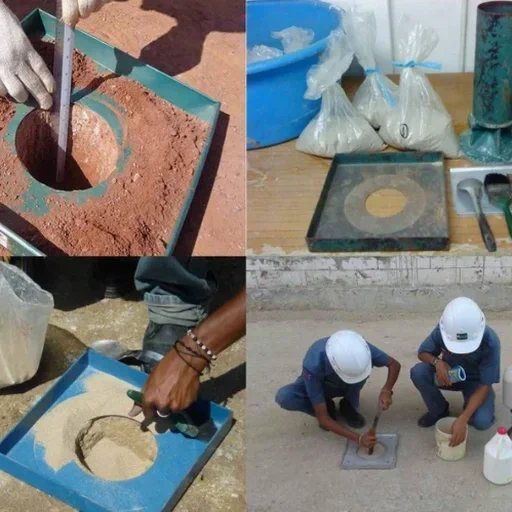
Builders working on the east side of Plano along the fertile Blackland Prairie face a completely different soil than those developing the Austin Chalk outcrops west of Preston Road. The dark, waxy clays near Murphy and Parker shift dramatically with moisture, while the limestone-rich terrain around Willow Bend offers more stable bearing but varied compaction response at shallow lifts. When a structural engineer specifies 95 percent modified Proctor on a retail pad off Legacy Drive, the only way to verify that number in real time is with an accurate field density test. Our team runs the sand cone method across Collin County subdivisions and commercial infill sites, delivering immediate dry density values that keep the earthwork moving. The procedure follows ASTM D1556, calibrated for the fat clays and occasional sandy lenses that make Plano's geology notably inconsistent from one street to the next.
A density reading of 92 percent on a fat clay subgrade in Plano isn't a pass until you've checked the moisture content against the curve.
Our approach and scope
Local considerations
The most common mistake we see on Plano job sites is running the sheepsfoot roller until the surface looks tight, then skipping the density test because the pad appears firm. A crusted-over fat clay can hold a loaded dump truck without visible deflection while the lift underneath sits at 88 percent relative compaction. When the first summer drought hits and the slab loses its moisture equilibrium, the edges curl and the floor cracks propagate from the garage to the kitchen. The sand cone method catches that hidden layer because the technician excavates through the crust into the suspect lift. On commercial projects east of US-75 where fill depths exceed four feet, we recommend a plate load test at subgrade elevation to confirm the modulus values assumed in the foundation design.
Relevant standards
ASTM D1556 - Standard Test Method for Density and Unit Weight of Soil in Place by Sand-Cone Method, ASTM D1557 - Standard Test Methods for Laboratory Compaction Characteristics of Soil Using Modified Effort, ASTM D2487 - Standard Practice for Classification of Soils for Engineering Purposes (Unified Soil Classification System), IBC Chapter 18 - Soils and Foundations
Related services
Standard Compaction Control Package
Includes modified Proctor laboratory compaction curve (ASTM D1557), field sand cone density tests at a frequency of one per lift per 2,500 square feet, and a stamped report with moisture-density curves and pass/fail criteria for each test point.
Deep Fill Verification Program
For commercial pads with engineered fill exceeding three feet. Combines sand cone density testing on each lift with nuclear gauge correlation checks and periodic undisturbed sampling for laboratory moisture content verification per ASTM D2216.
Typical parameters
Common questions
How much does a sand cone density test cost in Plano?
For most residential and light commercial projects in Plano, individual field density tests using the sand cone method range from US$90 to US$140 per test point, depending on mobilization distance and the number of points requested on the same visit.
How many density tests does the City of Plano require for a residential slab?
The City of Plano typically follows IBC requirements, which means a minimum of one field density test per lift per 2,500 square feet of building pad, though the geotechnical engineer of record may specify a tighter frequency based on the plasticity index of the site soils.
Can the sand cone method be used on granular base course under a Plano driveway?
Yes, the sand cone method works well on the crushed limestone flex base common in Plano residential construction, as long as the maximum particle size does not exceed the excavation diameter limitations specified in ASTM D1556.
What moisture condition is acceptable for a fat clay pad before the density test?
The field moisture content should be within 2 percent of the optimum moisture content determined by the modified Proctor curve. In Plano's Taylor Marl clays, this typically falls between 14 and 18 percent, and we verify it with a laboratory oven-dry test on the material excavated from the density hole.