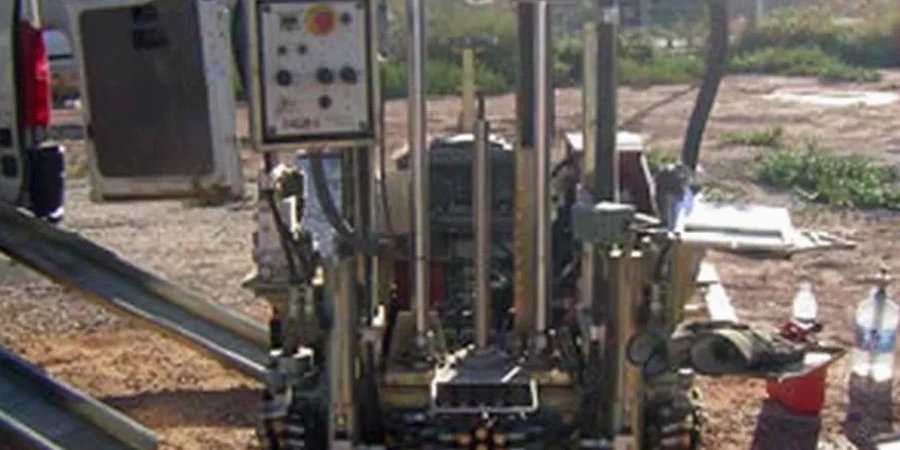
Structures in Plano rise on the complex, moisture-sensitive clays of the Blackland Prairie, where the International Building Code (IBC) and ASCE 7 mandate a precise understanding of subsurface behavior before a foundation is ever designed. A standard boring log often misses the subtle transitions between stiff and soft zones that govern settlement in this part of Collin County, which is why the Cone Penetration Test (CPT) has become the preferred investigative tool for many local geotechnical engineers. The method pushes an instrumented cone into the ground at a constant rate, recording tip resistance, sleeve friction, and pore pressure in a single, continuous profile that reveals exactly how the soil mass changes with depth. For projects near the Trinity River tributaries or along the expanding corridors west of US-75, this high-resolution data stream allows our team to identify problematic layers that could compromise pavement subgrades or deep foundations. We combine the CPT data with selective grain size analysis on recovered samples to calibrate the friction ratio and confirm the soil behavior type classification across the entire depth of interest.
Continuous CPT profiling in Plano's expansive clays reveals the thin, wet seams that cause differential heave and settlement, data that standard borings frequently overlook.
Our approach and scope
Local considerations
We have observed that many geotechnical reports in Plano rely too heavily on traditional borings spaced at wide intervals, which creates a false sense of security when a thin, saturated silt seam goes undetected between two exploratory points. The risk is not theoretical: a single unconsolidated layer, even just a few inches thick, can act as a drainage path that concentrates water beneath a slab, triggering localized heave and cracking that costs more to repair than the original investigation. The CPT eliminates this blind spot by generating a virtually uninterrupted record, but the data must be interpreted by someone who understands that the Robertson soil behavior chart was calibrated on soils quite different from the high-plasticity clays of North Texas. Our approach correlates the CPT pore pressure dissipation tests with atterberg limits measured in the laboratory, which anchors the continuous profile to the specific mineralogy of the local Eagle Ford and Austin Chalk formations. This level of integration is critical when the design team needs to decide between a stiffened slab, drilled piers, or a stone columns ground improvement strategy to mitigate differential movement.
Relevant standards
ASTM D5778: Standard Test Method for Electronic Friction Cone and Piezocone Penetration Testing of Soils, ASCE 7: Minimum Design Loads and Associated Criteria for Buildings and Other Structures, IBC (International Building Code): Chapter 18 on Soils and Foundations, ASTM D2487: Standard Practice for Classification of Soils for Engineering Purposes (Unified Soil Classification System)
Related services
Piezocone (CPTu) Testing and Pore Pressure Dissipation
We conduct seismic piezocone testing that measures cone resistance, sleeve friction, and dynamic pore pressure simultaneously. The dissipation tests provide the coefficient of consolidation, a parameter essential for estimating settlement rates in the saturated clays common beneath Plano.
CPT-Based Foundation Design Parameters
Using the continuous CPT profile, we derive undrained shear strength, effective friction angle, and constrained modulus through established correlations. The data is formatted for direct input into finite element models, allowing the structural engineer to optimize the foundation system for the specific stratigraphy encountered at the building pad.
Typical parameters
Common questions
How much does Cone Penetration Testing typically cost for a project in Plano, Texas?
For a standard CPT investigation in Plano, you can expect mobilization and testing rates to range between US$180 and US$280 per hour, with total project cost depending on the number of soundings, depth required, and whether pore pressure dissipation tests are included. A typical single-family residential lot might require a half-day program, while a commercial building pad with multiple CPT locations and deeper targets will be proportionally higher.
Why is CPT preferred over standard SPT borings for the expansive clays found in Plano?
The SPT provides a disturbed sample at 5-foot intervals, which can easily skip the thin, water-bearing silt partings that cause differential heave in Plano's clay profiles. The CPT produces a continuous, electronic record of tip resistance and sleeve friction that reveals every subtle change in soil stiffness, making it far more effective at identifying problematic layers and calculating settlement with greater precision.
Can the CPT data be used to design a post-tensioned slab on grade?
Yes, the continuous tip resistance and sleeve friction data from a CPT sounding are ideal for estimating the edge moisture variation distance and the differential swell potential required by the Post-Tensioning Institute (PTI) method. The high-resolution profile allows the engineer to confidently select the beam depth and rib spacing that will perform best in the specific clay conditions of your Plano site.
What is the typical depth of a CPT sounding for a commercial building in Collin County?
Most commercial investigations in Plano extend CPT soundings to a depth of 20 to 30 meters, or until refusal on the weathered shale bedrock. The depth is calibrated to capture the full zone of stress influence from the proposed foundation, including any deep, soft layers that could contribute to long-term consolidation settlement.