Plano sits on the Blackland Prairie at roughly 675 feet elevation. The terrain looks flat. But developers know the truth. Creek tributaries cut through the city. Rowlett Creek, White Rock Creek, Spring Creek. These waterways create slope conditions that demand careful geotechnical evaluation. In 2019, heavy spring rains triggered shallow failures along several residential cut slopes near Legacy Drive. That event reminded every civil engineer in Collin County why a rigorous slope stability analysis matters. Our team runs Spencer and Morgenstern-Price limit equilibrium models using real soil strength parameters. Not generic textbook values. We pull Shelby tube samples from the Eagle Ford Shale and the overlying Taylor Marl. Then we run consolidated-undrained triaxial tests. The friction angles and cohesion intercepts we input are site-specific. For Plano conditions, we typically see effective friction angles between 22 and 28 degrees in the weathered marl, with cohesion around 200 to 400 psf when the material stays unsaturated. The analysis changes fast after a 5-inch rain event. We also incorporate Cone Penetration Testing data to map weak layers that limit equilibrium software would otherwise miss.
A slope that stands today may fail tomorrow if the pore pressure regime changes. We model the worst-case hydraulic scenario, not the best day.
Our approach and scope
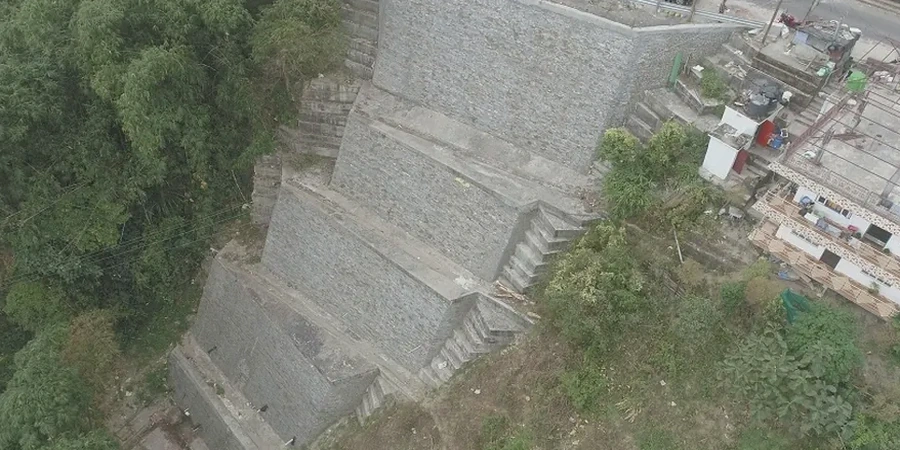
Local considerations
IBC 2021 Section 1803 requires geotechnical investigation for cuts and fills exceeding 5 feet. The City of Plano enforces this. No variance. No exceptions. A shallow slide on a 10-foot cut can expose a foundation, rupture a water line, or encroach on a neighboring property. The legal and repair costs exceed the analysis cost by a factor of 20. We model the slope with the groundwater table at the ground surface. That is the worst case. If the factor of safety still exceeds 1.5, the design is solid. If it drops below 1.0, we recommend stabilization. That might be a retaining structure, soil nailing, or a flattened geometry. Plano's expansive clay introduces another risk: progressive failure. Cracks from desiccation cycles reduce the shear strength over time. Our analysis uses fully softened strength envelopes for first-time slides in stiff clays, referencing Stark and Eid (1997) correlations with the liquid limit. When the soil has pre-existing shear surfaces, we drop to residual strength parameters. That conservative approach has kept our clients out of court.
Video resource
Relevant standards
IBC 2021 (International Building Code), Chapter 18, ASCE/SEI 7-22 Minimum Design Loads for Buildings and Other Structures, ASTM D1586 Standard Test Method for Standard Penetration Test (SPT), ASTM D2487 Standard Practice for Classification of Soils for Engineering Purposes, FHWA NHI-06-088 Soil Slope and Embankment Design
Related services
Embankment and Cut Slope Evaluation
Limit equilibrium modeling for commercial subdivisions, roadway widening along SH-121, and detention pond slopes. We deliver a signed report with cross-sections, critical failure surfaces, and recommended reinforcement if needed.
Retaining Wall Global Stability Analysis
MSE walls, cantilever walls, and soldier pile walls require global stability checks beyond the wall design. We model the composite failure surface that passes beneath the wall toe and exits at the crest.
Typical parameters
Common questions
What factor of safety does the City of Plano require for permanent slopes?
The city follows IBC guidelines, which call for a minimum static factor of safety of 1.5 for permanent slopes. For seismic conditions using a pseudo-static coefficient appropriate for Collin County, the minimum is 1.1. We confirm the exact requirement with the reviewing engineer before starting the analysis.
How much does a slope stability analysis cost for a Plano site?
For a typical residential or light commercial slope evaluation in Plano, the geotechnical investigation and stability modeling ranges from US$1,200 to US$3,760 depending on the slope height, number of cross-sections, and whether laboratory triaxial or direct shear testing is required.
Do you perform the soil borings in-house for the stability analysis?
We manage the entire process. Our drill crew mobilizes a truck-mounted rig to the site, advances borings per our sampling plan, and our lab runs the strength tests. The analysis uses data we generated, which gives us full control over quality and turnaround time.
What stabilization options do you recommend if the slope fails the stability check?
It depends on the failure mode and site constraints. Common solutions in Plano include installing a retaining wall at the toe, soil nailing the face, regrading to a flatter angle, or adding subsurface drainage to lower the phreatic surface. We evaluate cost and constructability for each option.