The surface geology across Plano is dominated by the Eagle Ford Shale and Taylor Marl formations, which weather into fat clays with plasticity indices routinely exceeding 25%. When a new retail pad in the Legacy West area shows 18 inches of tan, jointed clay at the subgrade, the structural engineer cannot finalize the slab-on-grade reinforcement until the Atterberg limits are known. We run the full suite—liquid limit, plastic limit, and plasticity index—in our Dallas-area lab following ASTM D4318, and we report results within 48 hours so the project stays on schedule. For preliminary exploration, crews often pair the sampling with test pits to log the weathered profile before selecting undisturbed specimens for the Atterberg tests.
A Plano clay with a plasticity index above 30 is not just sticky—it’s a structural load case that demands a moisture-stable foundation solution.
Our approach and scope
Local considerations
The soil profile changes dramatically between the eastern and western halves of Plano. East of US-75, the Taylor Marl produces highly plastic clays with PI values often exceeding 40, and we have measured liquid limits above 70 on samples from the Los Rios Boulevard corridor. West of Preston Road, the Eagle Ford formation yields silty clays with lower plasticity, but the presence of weathered shale fragments can skew the plastic limit if the material is not processed correctly. In one case near the Collin College campus, a contractor omitted the Atterberg limits on a warehouse addition, assumed a low-expansion CL soil, and ended up with slab heave of nearly two inches after a wet spring. The repair cost exceeded the original testing fee by a factor of fifty.
Relevant standards
ASTM D4318-17 (Standard Test Methods for Liquid Limit, Plastic Limit, and Plasticity Index of Soils), IBC 2021 Section 1803 (Geotechnical Investigations), ASTM D2487-17 (Standard Practice for Classification of Soils for Engineering Purposes — Unified Soil Classification System), Plano Building Code Amendments (adopting IBC with local expansive-soil provisions)
Related services
Atterberg Limits (ASTM D4318)
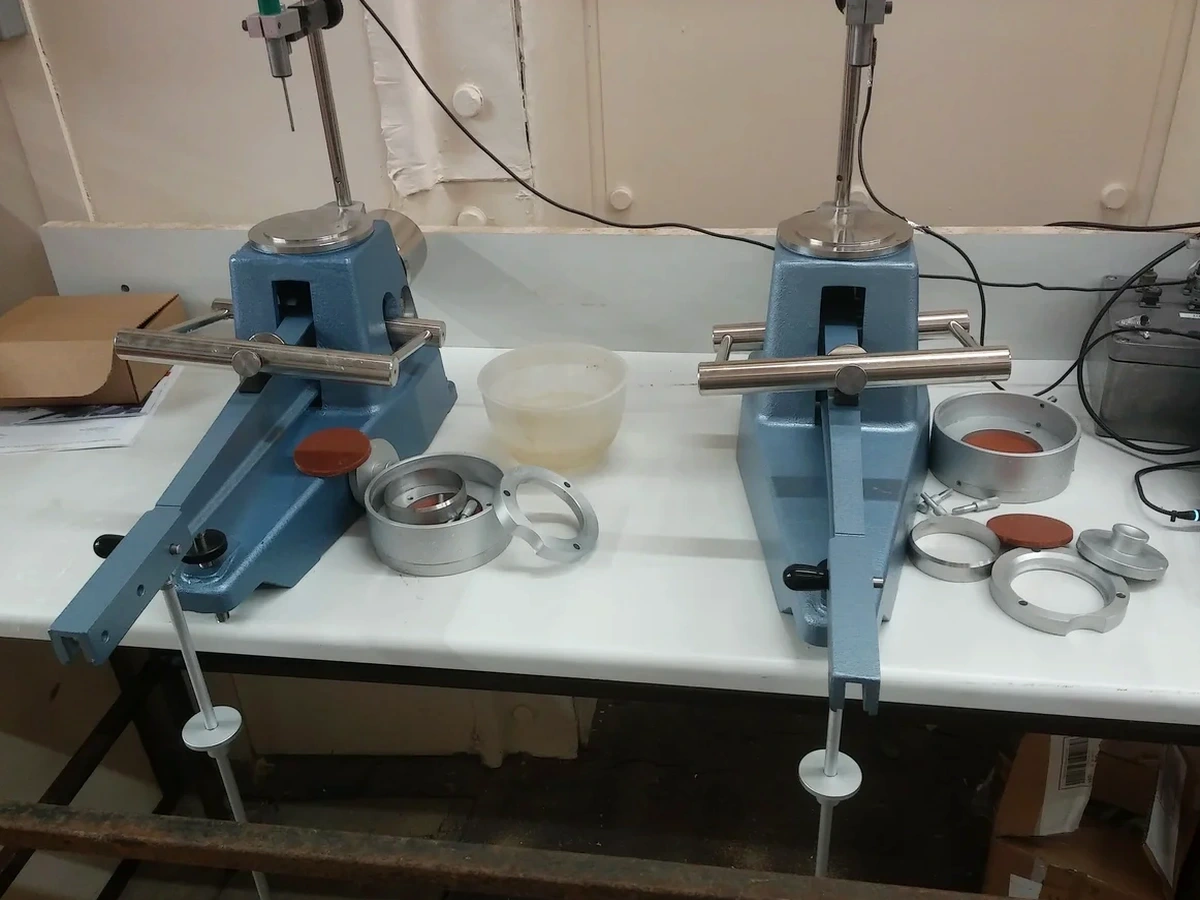
Multi-point liquid limit with Casagrande cup, plastic limit by rolling thread, and calculated plasticity index. Every report includes the USCS group symbol and a qualitative swell-potential rating based on the PI.
One-Point Liquid Limit (ASTM D4318 Method B)
Available for projects with tight deadlines where the full multi-point curve is not required. Our lab runs the one-point method on representative samples and correlates results with historical data from the same formation.
Full USCS Classification Package
Combines Atterberg limits with grain-size distribution via sieve and hydrometer per ASTM D6913/D7928 to assign a complete USCS group symbol and group name, essential for the geotechnical report.
Typical parameters
Common questions
How much do Atterberg limits tests cost in Plano?
For a standard multi-point liquid limit and plastic limit on a single sample, the fee ranges from US$50 to US$90 depending on the number of specimens and whether a one-point or full curve is requested. Volume pricing applies for projects with ten or more samples.
Why does the IBC require Atterberg limits for Plano foundations?
The IBC and the City of Plano amendments classify much of the local Eagle Ford and Taylor Marl as expansive soil. The plasticity index from the Atterberg test is the primary parameter used to estimate swell potential and to select the appropriate foundation type—stiffened slab, drilled pier, or structural floor—per the geotechnical report recommendations.
What is the difference between liquid limit and plastic limit for a Plano clay?
The liquid limit is the water content at which the clay transitions from a plastic to a liquid state, typically between 38% and 72% for Plano soils. The plastic limit, usually 14% to 24%, marks the boundary between semi-solid and plastic behavior. The difference between the two is the plasticity index, which directly quantifies the soil’s capacity to shrink and swell.