Drive east from the limestone-rich soils west of Preston Road into the deep, expansive clays near Murphy and you're essentially crossing two different construction worlds within the same city limits. The Standard Penetration Test in Plano, Texas becomes the translator for these transitions. In our experience, the Blackland Prairie clays that dominate the eastern half of Plano behave nothing like the sandy loams scattered through the older neighborhoods around Downtown. A builder who treats the entire city as uniform ground is gambling with slab performance. We run SPT borings at depths that matter—often 20 to 40 feet—to capture the weathered shale interface that underlies much of Collin County. When the clay seams are thin and the refusal depth is shallow, the design assumptions shift immediately, which is why we often pair the SPT data with a CPT test in areas where continuous stratigraphic profiling adds resolution between widely spaced boreholes.
An SPT blow count doesn't tell you the soil type—it tells you how the soil resisted the sampler. In Plano's expansive clays, that distinction determines whether your slab stays flat.
Our approach and scope
Local considerations
The 2021 International Building Code, as adopted by the City of Plano with local amendments, requires a geotechnical investigation for all commercial structures and explicitly references allowable bearing pressures derived from field exploration methods such as the Standard Penetration Test. What makes this requirement particularly acute in Plano is the prevalence of expansive clay soils classified as CH under the Unified Soil Classification System—soils that can exert swell pressures exceeding 5,000 psf when wetted after prolonged drought. We've reviewed forensic files where slab edge lift in a single-story residence along Parker Road exceeded 3 inches because the SPT exploration stopped above a desiccated crust that masked the underlying active zone. ASCE 7-22 further ties the seismic site class determination directly to SPT N-values in the upper 100 feet, which matters even in a low-seismicity region like North Texas because the site class influences the design spectral acceleration coefficients for mid-rise structures.
Relevant standards
ASTM D1586-18, IBC 2021 (Plano amendment), ASCE 7-22, ASTM D2487-17, TXDOT Tex-131-E
Related services
Standard Penetration Test Borings
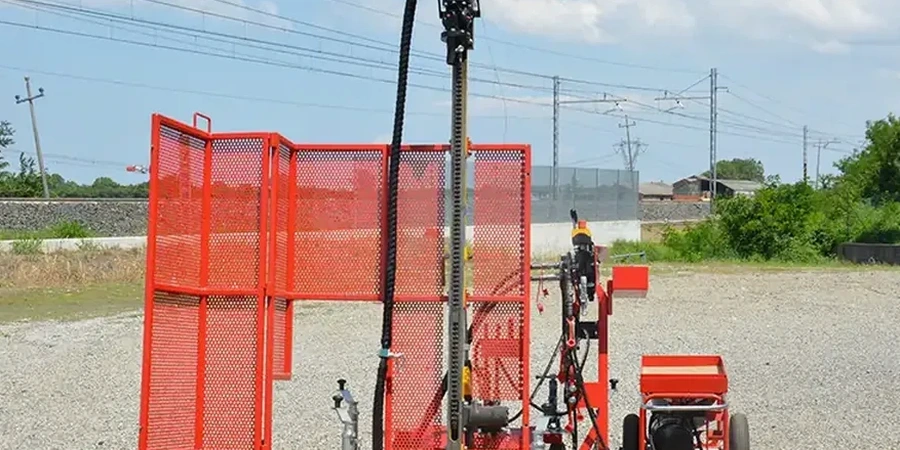
Truck-mounted or ATV rig SPT drilling to depths of 20 to 60 feet with split-spoon sampling at 5-foot intervals and at every stratum change. N-values are corrected for energy efficiency and overburden pressure, and each sample is visually classified by a field geologist using the USCS before being sealed for potential laboratory confirmation.
SPT-Based Foundation Analysis
We convert the field N-values into allowable bearing capacity using the Meyerhof and Bowles correlations, adjusted for Plano's clay consistency and proximity to the water table. The deliverable includes a bearing pressure map across the building footprint, an estimated modulus of subgrade reaction for slab-on-grade design, and recommendations for moisture conditioning or over-excavation where the active zone exceeds 10 feet.
Typical parameters
Common questions
How deep do SPT borings need to go for a single-family home in Plano?
The City of Plano typically requires borings to extend at least 20 feet below the proposed slab elevation, or to bedrock refusal, whichever comes first. In practice, we often go deeper—30 to 35 feet—in the eastern part of the city where the Taylor Marl can be weathered and the active moisture zone reaches beyond 15 feet. The depth must also satisfy IBC Section 1803 requirements for the number of borings based on building footprint, so a 3,000-square-foot home would usually require two borings to refusal or the planned depth.
What is the typical range of SPT N-values in Plano's Blackland Prairie soils?
In the upper 5 to 10 feet, N-values often fall between 4 and 12 in the stiff, desiccated clay crust. Below that, in the saturated, highly plastic zone, blow counts can drop to 2 to 6 until the boring reaches the weathered shale or limestone contact, where refusal—typically defined as 50 blows for 6 inches of penetration—occurs anywhere between 25 and 45 feet. Values vary sharply with seasonal moisture content, so we always note the rainfall history in the week prior to drilling.
How much does an SPT investigation cost for a residential lot in Plano?
For a standard two-borehole program on a single-family lot, with depths of 25 to 35 feet each, the cost generally falls between US$520 and US$840 per boring, depending on access conditions, the need for a smaller ATV rig in tight backyards, and whether laboratory testing on selected samples is included. The total investment for a complete report with bearing capacity analysis and pavement recommendations typically ranges from US$1,600 to US$3,200 for a residential project.
Can SPT data be used to determine if a Plano site needs a post-tensioned slab?
Yes, indirectly. The SPT provides the soil profile and the consistency of the clay layers, but the decision to specify a post-tensioned slab depends on the Potential Vertical Rise (PVR) calculation, which requires the Atterberg limits and moisture content from the SPT samples. When the PVR exceeds 1 inch, the Texas Section of the American Society of Civil Engineers practice guidelines recommend a stiffened slab design. In Plano, where PVR values frequently exceed 2 inches, post-tensioned slabs are the norm rather than the exception.