Plano sits at an elevation of roughly 675 feet on the Blackland Prairie, a formation notorious for its high-plasticity clays that can swell up to 10 percent in volume between dry summers and wet winters. This expansive behavior, documented across Collin County, exerts uplift pressures that crack slabs and distort frame structures if the foundation is not engineered specifically for it. A shallow foundation design that works in Austin will not hold up here; the soil requires a localized approach that accounts for moisture fluctuation, soil suction, and the depth of the active zone. We run the numbers on bearing capacity and heave potential using site-specific borings, and in many cases we pair the investigation with plate load testing to calibrate modulus of subgrade reaction directly in the field before finalizing reinforcement. With over 285,000 residents and commercial growth pushing into areas of residual clay, the margin for error keeps getting narrower.
A stiffened slab on Plano's fat clay is not a standard detail; it is a structural element calibrated to a specific soil suction envelope and a design life of fifty years.
Our approach and scope
Local considerations
The difference between a lot in Willow Bend and one near downtown Plano can be the difference between a stiff, overconsolidated clay crust and a deeper, softer alluvial pocket. In the eastern sectors, older fissured clays can hold a moisture profile that is relatively stable if left undisturbed, but a single leaking irrigation line or poor drainage turns them into a bowl of expanding material. In newer subdivisions, engineered fill is placed over residual clay, and if the fill is not compacted to at least 95 percent of standard Proctor density under controlled moisture, differential heave becomes almost guaranteed within the first five years. The biggest risk we see is not total settlement; it is edge lift and center lift distortion that rack door frames, shear drywall, and snap PVC plumbing below the slab. Once that movement starts, remediation costs far exceed the engineering budget, and insurance adjusters in Texas are increasingly scrutinizing whether the foundation design included a defensible geotechnical basis.
Relevant standards
IBC 2021 (Chapter 18: Soils and Foundations), ASCE 7-22 (Minimum Design Loads), ASTM D4546 (One-Dimensional Swell or Collapse of Soils), ASTM D2487 (Unified Soil Classification System), PTI DC10.5 (Post-Tensioned Slabs-on-Ground)
Related services
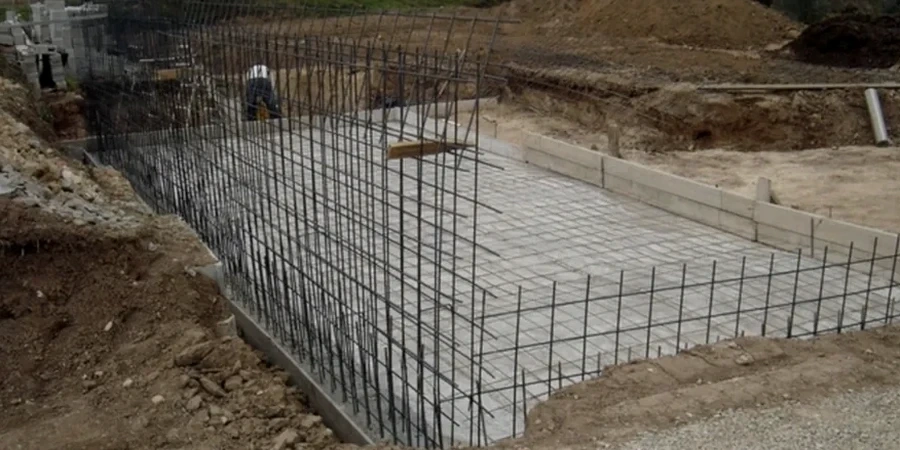
Stiffened slab-on-grade design
Ribbed or waffle slabs engineered for expansive soils, with void forms and perimeter moisture barriers sized to the measured swell potential and active zone depth.
Isolated and combined footing design
Reinforced concrete footings proportioned for bearing capacity and settlement, accounting for eccentric loads from steel frames and tilt-wall panels.
Mat foundation analysis
Thick plate mats analyzed for subgrade reaction modulus, with finite element models that capture soil-structure interaction and differential heave.
Typical parameters
Common questions
What makes Plano's soil so hard on shallow foundations?
The Blackland Prairie clays beneath Plano have a high plasticity index, typically between 25 and 45, which means they expand significantly when wet and shrink when dry. This volume change creates cyclic uplift and settlement that a standard slab cannot resist without stiffening ribs or post-tensioning designed specifically for the local active zone, which can reach 16 feet deep.
Do I always need a geotechnical report before foundation design?
Yes, and the IBC requires it. A site-specific report with borings, Atterberg limits, swell testing (ASTM D4546), and moisture profiles is the only way to determine the design parameters for bearing capacity, heave, and slab stiffness. Without it, any design assumption is a gamble.
How much does a shallow foundation design cost for a typical home in Plano?
For a single-family residence on an average lot, the engineering design and analysis typically range from US$1,730 to US$2,970, depending on the complexity of the soil profile and whether post-tensioning or conventional reinforcement is selected.
What is the difference between a stiffened slab and a post-tensioned slab?
A stiffened slab uses deeper beams and conventional rebar to create rigidity against soil movement, while a post-tensioned slab uses high-strength steel tendons tensioned after the concrete cures to actively compress the slab and control cracking. The choice depends on the plasticity index, the predicted edge lift, and the architect's tolerance for slab thickness.