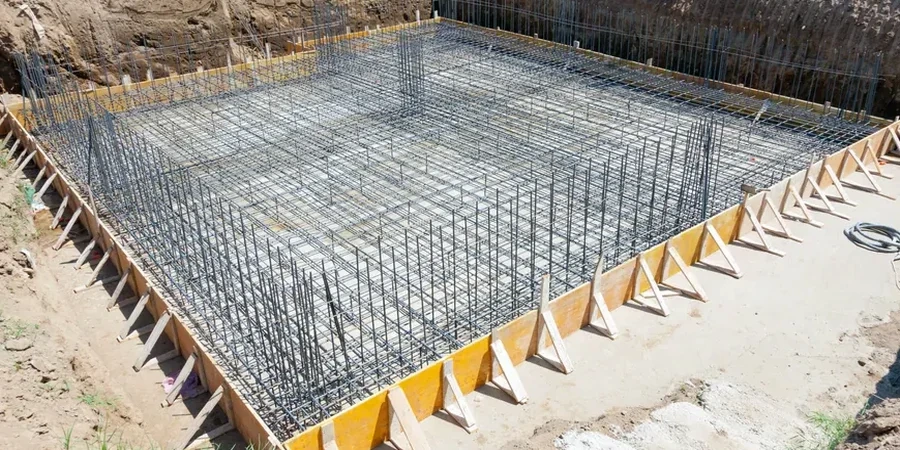
Plano’s transformation from a small farming settlement to a major corporate hub brought with it a surge in large-scale commercial and residential construction that now sits directly atop the notorious Eagle Ford Shale. This Cretaceous-age formation, which underlies much of Collin County, is characterized by its high plasticity and extreme potential for swell-shrink behavior with seasonal moisture changes. Designing a raft or mat foundation here is not just about distributing loads; it is fundamentally about managing the differential heave that can crack slabs and compromise structural integrity. The engineering challenge involves predicting soil movement from a detailed grain-size analysis and moisture content profiling, then modeling a stiffened slab-on-ground or a structural mat that acts as a single unit to resist deformation. Our technical team approaches each project by first reconciling the site-specific subsurface data with the performance requirements of the superstructure, ensuring the foundation design is a tailored response to Plano’s unique geological narrative rather than a generic solution.
In Plano’s expansive clay, a well-designed mat foundation functions as a stiffened raft that bridges over zones of differential heave rather than trying to restrain the soil’s natural moisture-driven movement.
Our approach and scope
Local considerations
With over 290,000 residents and a dense concentration of corporate campuses, Plano has seen its share of foundation distress, particularly in older structures built before modern post-tensioning methods became standard in the 1990s. The primary risk stems from the non-uniform moisture fluctuation at the perimeter of the slab, which creates an edge drop or center heave mechanism that can exceed the deflection tolerance of brittle finishes. A mat foundation designed without accounting for the Thornthwaite Moisture Index specific to North Texas will inevitably be under-designed for the true climatic wetting and drying cycles. The secondary risk is plumbing leaks beneath the slab, which introduce a point source of moisture into the active zone and can trigger localized heave exceeding 4 inches—far beyond what a conventional slab can tolerate without structural cracking. By integrating deep beam systems and a properly moisture-conditioned pad, the design creates a balanced system where the foundation moves slightly as a rigid body rather than fracturing at critical load-bearing points.
Relevant standards
Post-Tensioning Institute (PTI) DC10.5-19: Standard Requirements for Design and Analysis of Shallow Post-Tensioned Foundations on Expansive Soils, IBC 2021 / IRC 2021: Section 1805 on foundation design and expansive soil mitigation, ASTM D4546: Standard Test Methods for One-Dimensional Swell or Collapse of Soils, ASCE 7-22: Minimum Design Loads for Buildings and Other Structures
Related services
Geotechnical Site Characterization
Drilling and sampling through the Eagle Ford formation to determine the active zone depth, Atterberg limits, and in-situ moisture profiles that govern the swell potential at the specific Plano site.
Post-Tensioned Slab Design
Engineering of ribbed or uniform thickness post-tensioned mat foundations using the PTI method, calibrated to the measured PVR and edge moisture variation distance for the North Texas climate.
Fill and Moisture Conditioning Plans
Specification of select fill materials, compaction criteria, and pre-wetting or lime treatment procedures to create a stable, moisture-controlled subgrade before the mat is cast.
Typical parameters
Common questions
What is the typical cost range for designing a raft or mat foundation for a single-family home in Plano?
For a standard residential project in Plano, the geotechnical investigation and the structural design of a post-tensioned mat foundation typically range from US$1,130 to US$3,880, depending on the size of the structure, the depth of borings required to penetrate the active zone, and the complexity of the slab geometry. Commercial mat designs for larger footprints fall on the higher end of the spectrum due to the more extensive soil-structure interaction modeling required.
How deep do you need to drill to characterize the soil for a mat foundation in the Eagle Ford Shale region?
Boreholes for a mat foundation design in Plano generally extend 15 to 25 feet below the proposed slab elevation, or until we penetrate at least 10 feet into the weathered shale where the moisture content stabilizes. The exact depth is governed by the need to define the full active zone—the depth within which seasonal moisture changes cause significant volume change—and to confirm that there are no deeper paleo-channels filled with more problematic alluvial deposits.
Does a mat foundation completely eliminate the risk of slab movement on expansive clay?
No foundation system can entirely eliminate movement on Plano's highly expansive Eagle Ford Shale, but a properly designed mat foundation manages the movement to keep it within tolerable limits. The stiffened ribs and post-tensioning allow the slab to act as a rigid unit, minimizing differential deflection. The key to performance is maintaining consistent moisture around the perimeter through drainage and landscape management, which prevents the edge drying and wetting cycles that drive most differential heave.